Container, 1 column
1 column
1/2 column
1/2 column
1/3 column
1/3 column
1/3 column
1/3 column
2/3 column
1/4 column
1/4 column
1/4 column
1/4 column
1/4 column
3/4 column
1/5 column
1/5 column
1/5 column
1/5 column
1/5 column
1/5 column
4/5 column
1/6 column
1/6 column
1/6 column
1/6 column
1/6 column
1/6 column
1/6 column
5/6 column

Sustainable Swaps: School Lunch & Snack Containers
Single-use products, like Ziploc bags, plastic wraps, and aluminum foil, are the most common way American families wrap up their snacks and lunches on the go. Their convenience, however, comes at a cost. Each year, millions of single-use bags and tons of plastic wrap end up in the trash, either to be incinerated (producing harmful chemicals that pollute our air) or to be landfilled (taking up to 450 years to decompose, breaking down into microplastics along the way). Not to mention, the production of plastic-based disposables emits significant amounts of greenhouse gases, contributing to the acceleration of the climate crisis.
Do you opt for aluminum foil to wrap sandwiches or other lunch items? Although clean aluminum foil is recyclable, we always recommend opting for reusable over single-use products.
As you prepare for the upcoming school year, consider breaking up with disposable lunch and snack containers. By switching to eco-friendly alternatives, you can actively reduce plastic waste, protect our environment, and combat climate change. Investing in reusable can also be more economical in the long run, with products offering superior functionality and durability when compared to traditional throw-away options.
An important note: When shopping for plastic bag alternatives, you may come across products that are labeled “compostable”. While these options are generally more sustainable than traditional plastic bags, any product that is designed to be used once and then discarded is not ideal. Also, many of these products CANNOT be composted; They are not accepted at the Westport Transfer Station, and many private haulers will not accept them.
Instead, consider these wonderful eco-friendly alternatives, many of which can be found locally as well as online retailers like Amazon or EarthHero. Once you start searching, you’ll find there are many other sizes and styles of reusable products for you to choose from!

Stasher Silicone Reusable Storage Bag
Containing no BPA, PVR, or latex, their trademarked airtight seal keeps food fresher for longer. They’re also dishwasher and microwave-safe. Shop here.
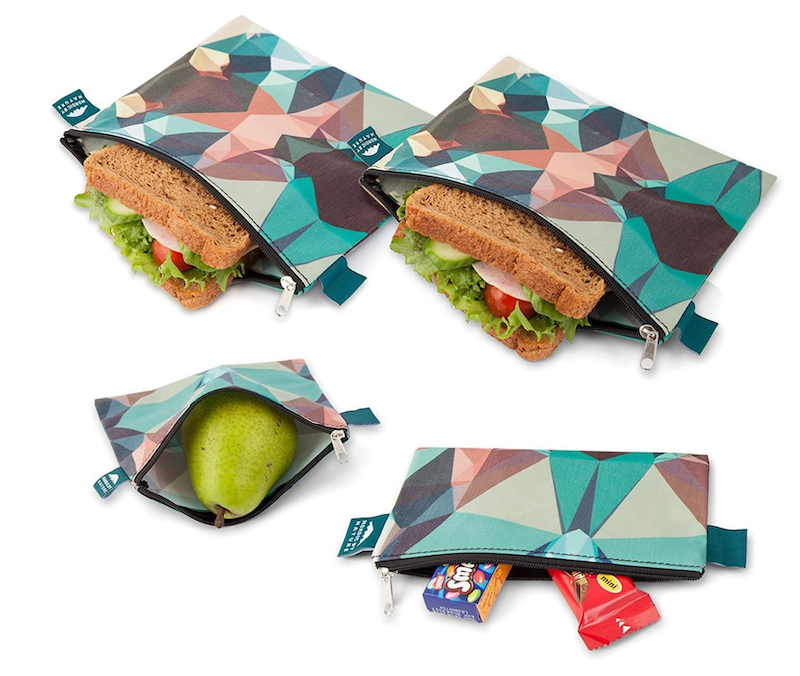
Nordic By Nature Eco-Friendly Sandwich Bags
Reusable cloth bags are another great alternative to Ziploc bags. Nordic by Nature offers a variety of sizes that are dishwasher or washing machine-safe. They are highly durable and easy to open and close. Shop here.
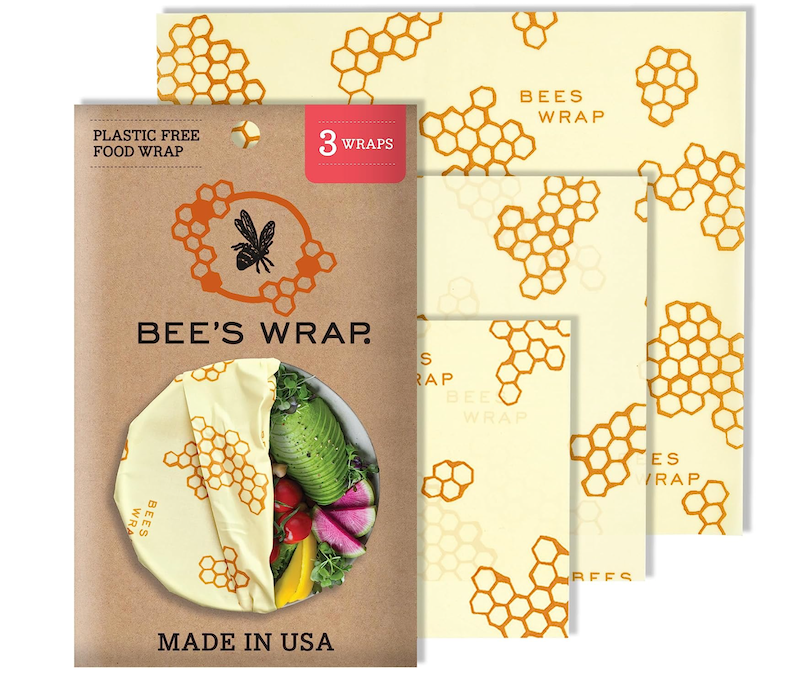
Bee’s Wrap – Reusable Beeswax Food Wraps
Made with organic cotton, beeswax, tree resin, and plant oils, Bee’s Wrap food wraps make excellent eco-friendly sandwich wraps or covers for your leftovers. Wrap or cover the item with beeswax wrap and use the warmth of your hands to create a seal. To reuse it, remove the wax carefully, rinse it with soap under some cold water, and let it air dry. Bee’s Wrap also offers vegan food wrap, which is created using plant-based materials rather than animal-derived ingredients. Shop here.

Everusely Stainless Steel Snack Containers
These 304 stainless steel containers are crafted with lids made of food-grade silicone. Containing no plastic, these containers are a snack and lunchtime game changer. Shop here.
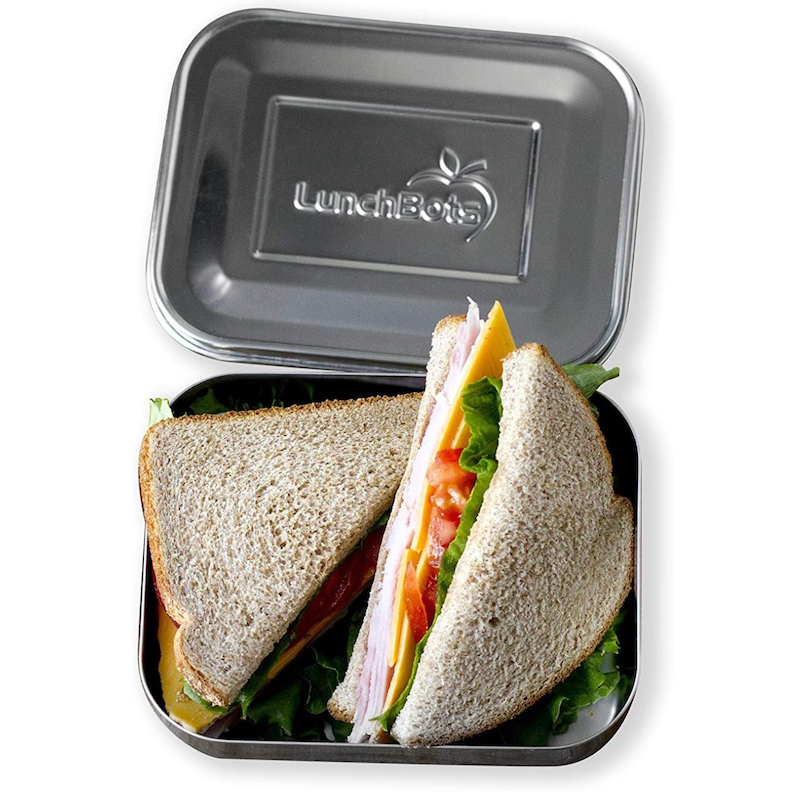
LunchBots Stainless Steel Sandwich Box
Designed to fit a sandwich, this one-compartment bento box is perfect for your child’s favorite lunchtime meal. LunchBots offers a variety of stainless steel bento-style boxes. Shop here.
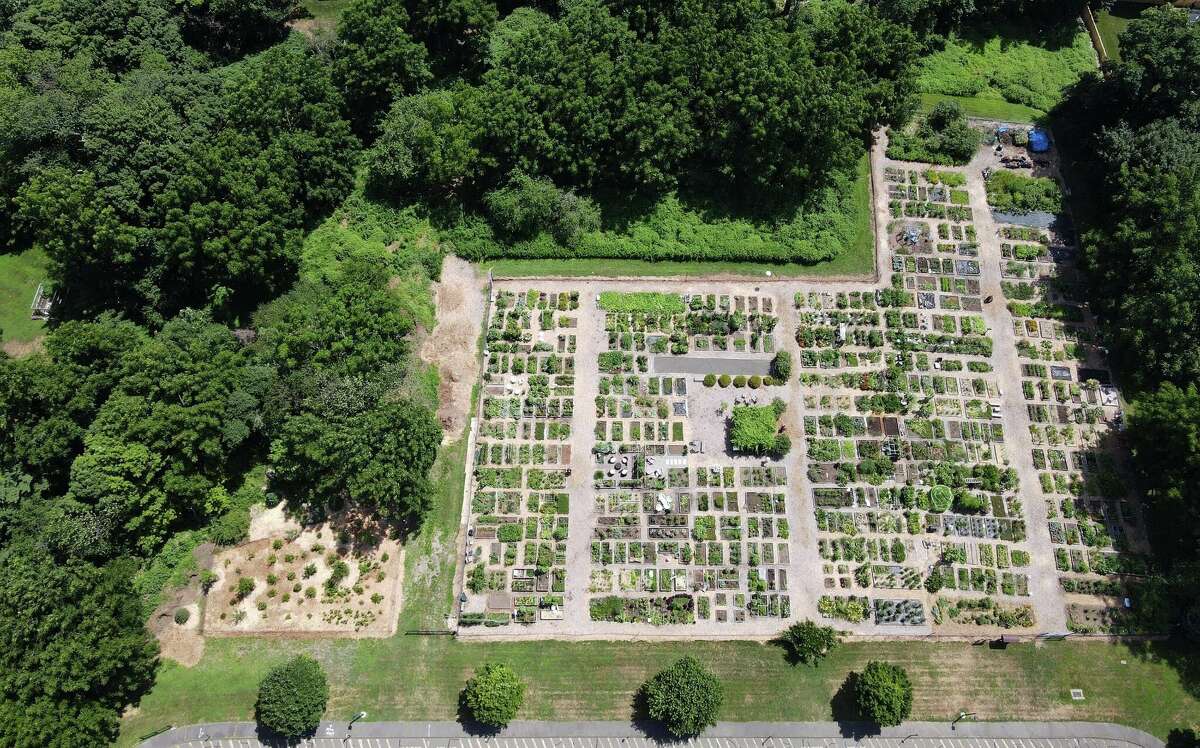
Long Lots Building Committee: Supporting Our Commitment to Becoming Net Zero by 2050
We are inspired by our community’s response to the Long Lots Building Committee’s consideration of plans to relocate the Westport Community Gardens and Long Lots Preserve. As hundreds of residents have already stated, the Community Gardens are a valuable community asset. Not only do they support exceptional programs like Grow-A-Row, but they are also emblematic of the type of spaces Westport wants to promote and foster – a natural resource that provides flood storage, wildlife habitat, and tree canopy while also providing an educational and enriching environment for our community. Sustainable Westport wholeheartedly supports preserving the Community Gardens and building a sustainable school to support our Town’s commitment to use best efforts to become a Net Zero community by 2050.
As a non-profit organization dedicated to supporting individuals, businesses, and our Town government in making changes to reduce our overall carbon footprint, Sustainable Westport recognizes the immense opportunity this project represents for our community; Westport has not built a new school from the ground up since 2001, and prior to that, not since 1965.
In a recent letter to the Selectwomen and the RTM, Save Westport Now shared several important observations about proposed plans to relocate or modify the Community Gardens and Preserve. Although Sustainable Westport was not invited to participate in the committee, our team has made every effort to attend all public committee meetings and has used our platform to encourage our community to make their voices heard.
Since last October, Sustainable Westport has shared informative content both with the committee and the public to educate residents about the advantages associated with constructing a sustainable school. Sustainable schools deliver significant health, educational, financial, and environmental benefits to students, teachers, and communities. Not only are sustainable schools more energy efficient, leading to lower operating costs, but they also provide learning spaces that significantly improve the wellness and productivity of those in and around the building. Learn more here.
We also strongly advocated for sustainability to be included as a primary objective for the Long Lots Building Committee. In fact, the resolution appointing the committee includes the directive to incorporate “sustainable and energy efficient design practices to the extent possible into the scope of work as appropriate to achieve the best long term value for the Town, in support of the 2017 resolution committing Westport to use best efforts to become a Net Zero community by 2050.” We have been pleased by the committee’s willingness to explore sustainable options for each potential outcome: renovate, renovate and expand, or build new. Most considerations focus on energy, including solar, geothermal, ground-source heat pumps, and insulation. However, we have also heard discussions about installing dishwashers (to reduce the single-use waste), induction stovetops, using mass timber and concrete to lower embodied carbon, implementing rain gardens and sustainable landscaping, and using grey water or a retention pond for irrigation. As these examples illustrate, the umbrella of “sustainability” is complex and far-reaching.
Our ask is simple.
Please extend your energy and enthusiasm beyond protecting the Community Gardens and Long Lots Preserve, a long-standing example of our community’s commitment to sustainability, by also advocating for establishing a school that aligns with the Town’s objective of achieving Net Zero status by 2050. Let us work together to encourage the Long Lots Building Committee to both preserve our existing natural resources and create new infrastructure that reinforces our shared dedication to sustainability.
Please contact your RTM and the Westport Board of Education to inform them that you support the Town of Westport investing in Net Zero infrastructure, including schools and other public buildings. Also, keep apprised of the Long Lots Elementary School Building Committee meetings; join when you can and make your voice heard! To sign up for email alerts when meetings are announced, please click here, then add your email address under “Subscribe to Meet & News Updates.” Next, under “Calendar,” select “Long Lots School Building Committee.”

Sustainable Westport Superstar: Rizzuto’s Oyster Bar & Restaurant
Congratulations to Rizzuto’s Oyster Bar & Restaurant for being named our latest Sustainable Westport Superstar. After years of composting at home, restaurant owner Bill Rizzuto took on the challenge of implementing a food scrap program at his business after being introduced to Sustainable Westport. With the help of Curbside Compost, Rizzutos now has four 32-gallon food scrap carts being picked up for composting once a week!
What have you learned about food scrap recycling that you wish more people would know?
More than anything, this process has raised our awareness of the volume of organic materials that are going to landfills/incinerators. There are so many things we now compost: oyster, clam, and seafood shells, meat, poultry, and fish trim, vegetable skins, not to mention food leftover on our guests’ plates. It feels great knowing we are contributing our excess food products going back into the earth.
Any advice you would give to other businesses considering composting?
I wanted to implement composting into my business for a long time but was held back by the logistics of composting the high volume of food scrap. After being connected to Curbside Compost through Sustainable Westport, I decided it was time to take on the challenge.
The biggest challenge was working with staff to re-train and break the habits of how we handle food waste. It took time, but our staff remained dedicated to implementing change and are really proud of what we are doing.
While it is too early to assess whether there is any economic benefit for our business, it is clear that our regular trash dumpster is much less full during Monday morning pickup. In the first three months of composting, we recovered 2,000 lbs of food scraps, equivalent to 1,220 lbs of CO2 or 1,391 miles of driving.
In addition to implementing a composting program, Rizzutos has also opted to swap all carry-away packaging for biodegradable, recycled paper products. Ultimately, their goal is to ensure all takeout products are 100% recyclable or compostable.
THANK YOU, Bill Rizzuto and the entire Rizzuto’s Oyster Bar & Restaurant staff, for being a Sustainable Westport Superstar!

Westport Police Continue to Invest in EV
Blog Partner: Barry Kresch, President of the EV Club of CT
The Town of Westport is making great strides toward a greener and more cost-effective future by continuing to adopt more electric vehicles (EVs). The Police Department added two new EVs to its fleet, including an all-terrain utility vehicle and an electric motorcycle, and is expecting its third Tesla patrol car this summer. In addition to these new vehicles, the department has already incorporated seven plug-in vehicles, including two Tesla patrol cars (Model 3 and Model Y), a Toyota Prius Prime Plug-in Hybrid, a Honda Clarity PHEV, a BMW i3 Battery Electric Vehicle, and a Ford Interceptor conventional hybrid patrol car.
The department’s new all-terrain utility vehicle is powered by six 12-volt batteries lasting between 8-12 hours. Although it looks like a golf cart, the vehicle can drive across terrains (including sand) and includes a winch for heavy-duty applications. You might see the vehicle at Compo Beach or Winslow Park, which is used frequently when policing Westport Parks.
The Zero electric motorcycle, which replaced a retired Harley, will be used for parking and traffic enforcement. Zero is a brand of electric motorcycles known for their advanced technology and long-range capabilities. It contains a 17.3 kWh battery and is rated for a range of 183 miles in the city and 85 miles on the highway, which Westport Police Chief Foti Koskinas was proud to confirm has been achieved during the bike’s first few weeks of use.
In 2019, the Westport Police purchased its first electric patrol vehicle, a Tesla Model 3, for $52,000. At the time, the incumbent gasoline-powered Ford Explorer ICE was $37,000, and skeptics were concerned that fuel savings would not be significant enough to overcome the $15,000 purchase premium. However, the EV Club of Connecticut recently completed an analysis of the expected savings in fuel, maintenance, customization, and expected vehicle life of the Tesla Model 3. Over a 4-years, the Model 3 is projected to save the Town of Westport $50,000, with the $15,000 purchase premium recouped in its first year!
With continued price-cutting by Tesla and EV incentive programs, electric vehicles are now less expensive than the traditional Ford Explorer ICE police vehicle. If purchased today, a Tesla Model Y would cost $37,990 ($47,740 purchase price with a $2,250 CHEAPR rebate and IRA incentive), continuing to make the acquisition cost of an EV less than its gasoline-powered counterpart.
In addition to the reduced acquisition costs, Tesla vehicles also are expected to provide a longer service life. The original amortization schedule was projected based on a six-year service life, compared to the expected four-year service life of the Ford Explorers. The Teslas have held up well, with maintenance costs aligned with the forecast. The department is hopeful that actual service life will reach eight years, equating to double the Explorer’s service life.
Switching to electric vehicles in the Town of Westport’s Police Department fleet is environmentally friendly and cost-effective. Lower acquisition costs, fuel costs, maintenance costs, and double service life make them an exceptional alternative to gas-powered vehicles. Kudos to the Westport Police for continuing to be a leader amongst police departments and municipalities nationwide.

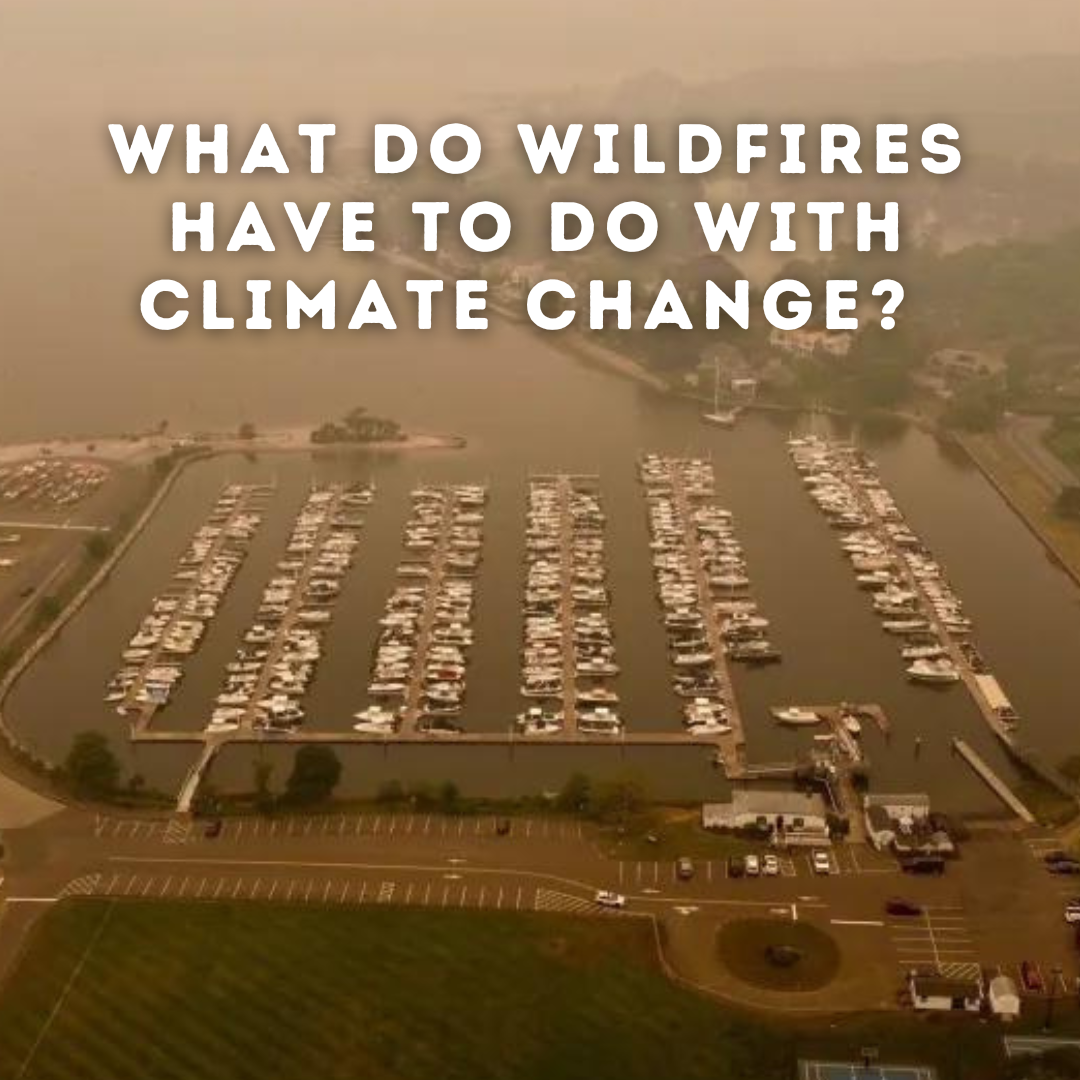
What do Wildfires Have to do with Climate Change?
Before we start, we want to highlight that this is a complex, interconnected issue. We highly recommend reading our beginner’s guide to net zero for a high-level overview of climate change as well as a more comprehensive list of things individuals can do to help Westport reach our collective goal of becoming net zero by 2050.
The release of greenhouse gases into the atmosphere causes the Earth’s temperature to rise by trapping heat from the sun like a blanket. As our planet warms, so does the temperatures of the water in our oceans. Warmer water changes the patterns of currents, which affects global weather patterns (some places become more susceptible to drought and wildfires, while others experience stronger tropical storms, flooding, and erosion). Multiple studies have found that climate change has already led to an increase in wildfire season length, wildfire frequency, and burn area. Canada is on track to have its most destructive wildfire season in history – a season that lasts through October.
While we can’t stop the wildfires or their impact on our air quality, there are things we can do to help reduce the amount of air pollution that we produce locally. These small changes can collectively make a big impact.
- Stop idling. Idling vehicles contribute to air pollution and emit air toxins. Not only is it THE LAW to turn off your engine, but you’ll also help the environment and prevent toxic chemicals from polluting our air and lungs. Not to mention, if you are going to wait more than 10 seconds, it uses less gas to restart your car than it would to keep it running. Commit to turning off your engine – particularly when you are around vulnerable populations like children!
- Use public transportation/carpools. According to a report from the American Lung Association, Fairfield County has among the poorest air quality in the nation due to local transportation emissions and smog blowing in from other states. When multiple people share a ride or opt for public transportation, it reduces the number of vehicles on the road, which in turn reduces traffic congestion and decreases the emission of harmful pollutants. It can also save you time and money!
- Avoid using gas-powered lawn and garden equipment. Small engines, like those found in gas leaf blowers, are a larger source of smog-forming emissions than passenger cars! Due to their impact on human and environmental health, Westport already has a gas leaf blower ordinance currently in effect, which limits their use from May 15-October 15 and by 2024 will ban them outright. Invest in electric tools instead!
- Reduce your total waste. All of our trash is incinerated in Bridgeport (only a few miles away!). The more trash you generate, the more air pollution is released locally. Looking for tips on how to reduce waste? Click here!
- Stay informed. The EPA offers additional tips for how individuals can reduce air pollution.
This week has been an illustrative example of the phrase “climate change knows no borders.” As global warming continues, wildfires (and other extreme weather patterns) will become more frequent and widespread. If we do nothing, this is our new reality.
Get informed, get involved, and BE PART OF THE SOLUTION! Sign up for our newsletter and be sure to follow us @sustainablewestport on Facebook and Instagram for more!

Climate Justice Speaker Discusses the Intersection of Environmental and Racial Justice
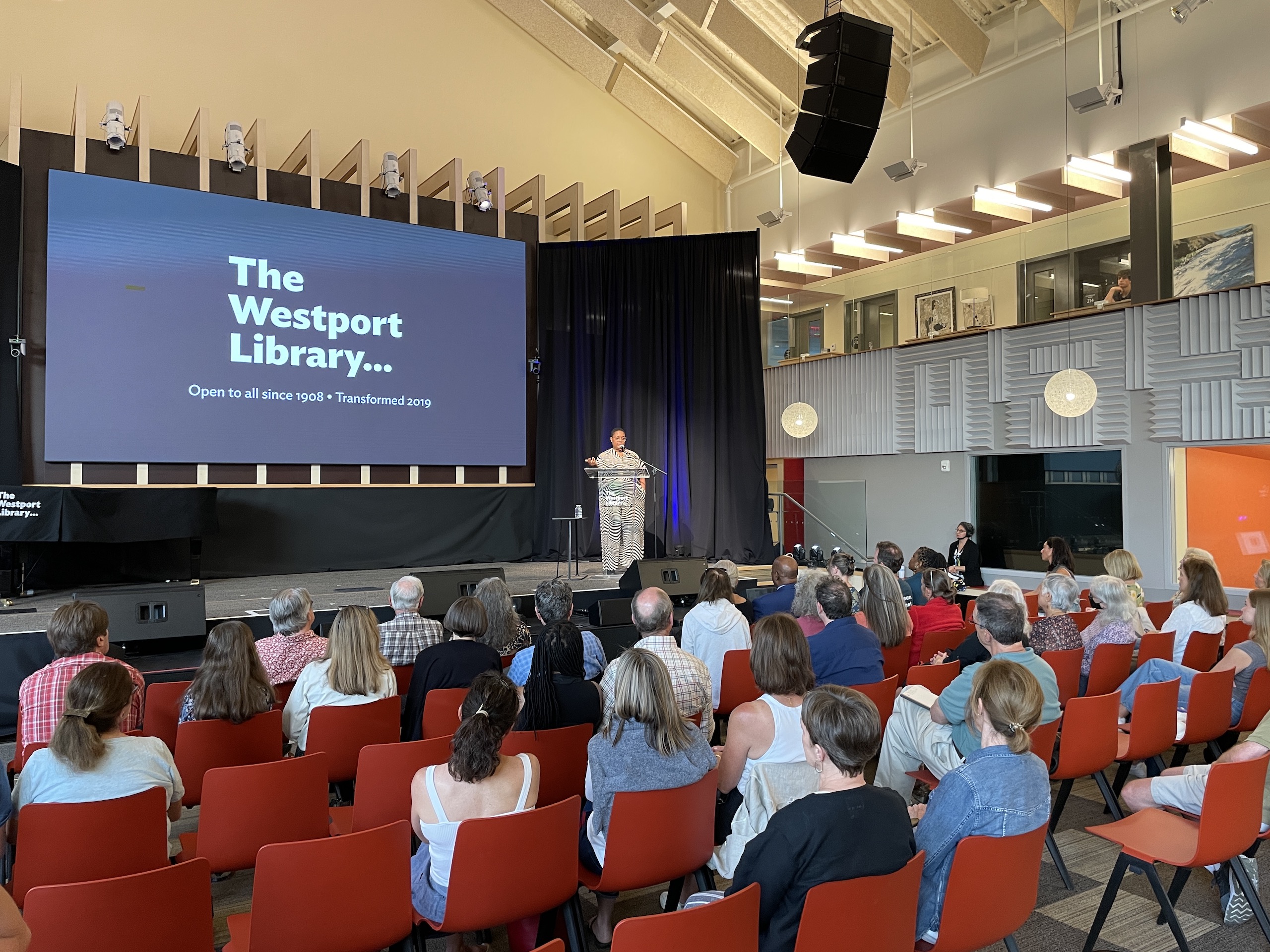
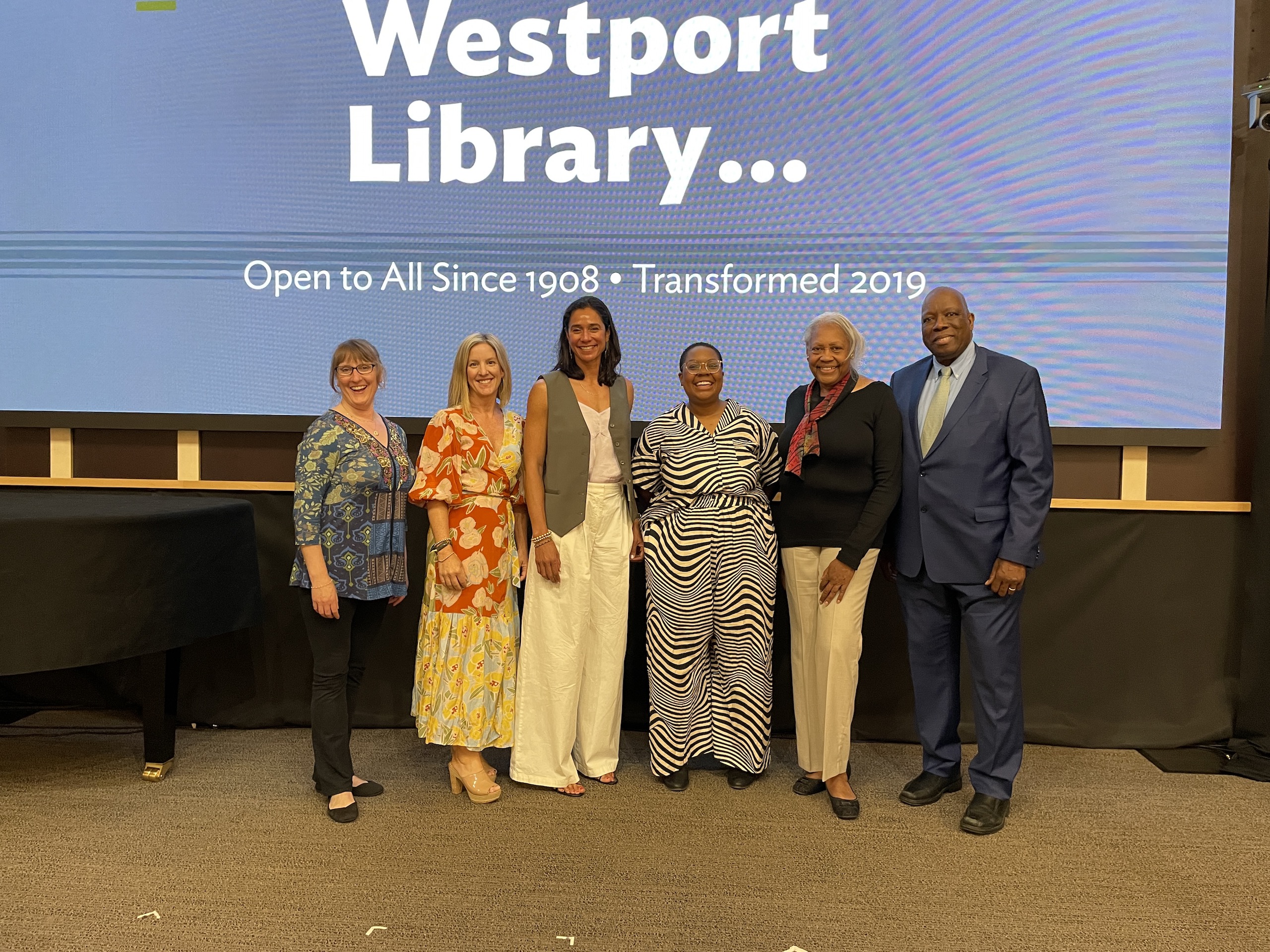
The Westport Library, Saugatuck Congregational Church, Sustainable Westport, and TEAM Westport recently partnered to bring Roosevelt Institute Director of Climate Policy and environmental justice advocate Rhiana Gunn-Wright to Westport for a special event entitled, “It’s All Our Backyard: Just Transitions to Regional Sustainability.”
Ms. Gunn-Wright started the conversation by sharing her journey from a young girl growing up on the south side of Chicago to becoming one of the architects of the Green New Deal and the Director of Climate Policy at the Roosevelt Institute. She described learning about environmental justice during her time as a policy analyst in Detroit and the powerful connection she made to her own personal experience living in a frontline community, suffering from asthma caused by pollution in her neighborhood.
Throughout the talk, Ms. Gunn-Wright shared examples that emphasized the interconnection of environmental and racial justice. She explained, “There is no way to talk about the climate crisis without talking about race. You aren’t adding an extra dimension, you’re just acknowledging a dimension that already exists.” In addition to sharing details and statistics, she continually highlighted how unjust policies and practices disproportionately impact people of color, not only economically but physically and emotionally as well.
After taking questions from the audience, Ms. Gunn-Wright shared her recommendations on how to create change as an individual; by voting, supporting local environmental justice organizations, and constantly creating pressure on organizations and government to do better.
The talk was inspired by Westport’s commitment to becoming a sustainable, thriving community — economically, environmentally, and socially — and by our ongoing community-based efforts to dismantle systemic racism. Brought to you by The Westport Library, Saugatuck Congregational Church, Sustainable Westport, and TEAM Westport.
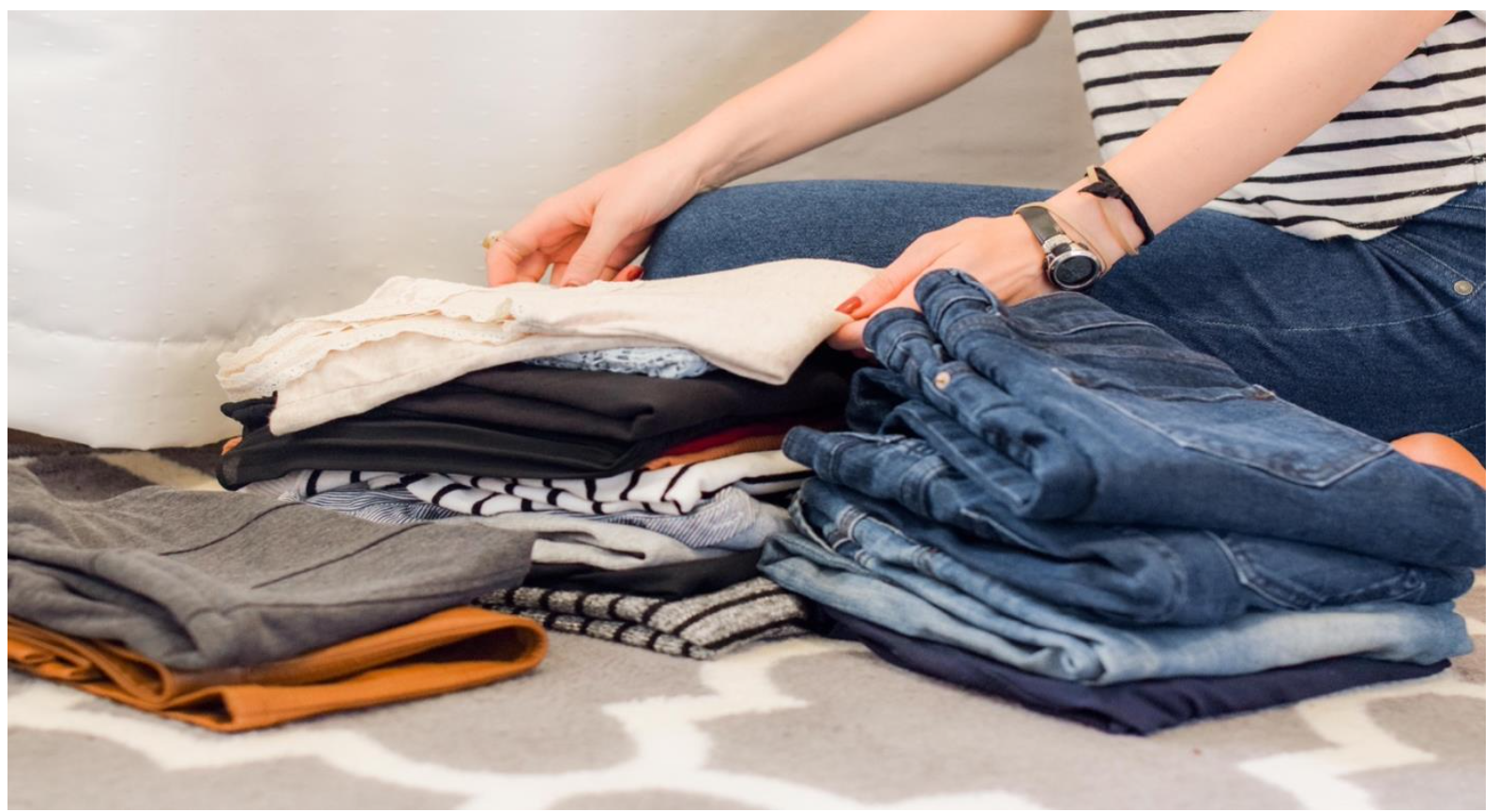
Textile Waste: Reduce, Reuse, Recycle
Guest blogger Jaclyn Noble is an experienced and accomplished textile supply chain expert with over 20 years of leadership experience for renowned USA retail brands including Spanx, Coach, The North Face, and Victoria’s Secret. Originally from Scotland, she obtained her degree in Textile Technology before relocating to Hong Kong. In 2002, she settled her family in Westport, where she has been an active member of the community. Jaclyn is the proud mom of three, fun, young adults who all attended Long Lots, Bedford, and Staples. Additionally, she shares her life with two beloved Spaniels, Maxi, and Sunny, who can frequently be seen enjoying Winslow Park.
Do you ever wonder where all your discarded textiles go?
Do you long to find your much-loved apparel a wonderful second home?
Do you worry you’ve loved your garments way too much to recycle?
The average American throws away 80 pounds of clothing per year. While we hope to reduce the overall amount of textile waste we produce, the good news is that 95% of worn or torn textiles can be donated or recycled. The bad news is only 15% are, which contributes to a massive global waste issue.
The environmental impact of textile waste has spiraled out of control. With the apparel sector contributing to approximately 10% of the annual global carbon emissions, this fraction is projected to grow to more than 50% by 2030. Having worked in the apparel industry for over three decades, I have witnessed the relentless pace of fast fashion, and textiles becoming one of the largest polluters in the world.
There is some good news! Westport is recycling more and more of its textile waste.
Bay State Textiles, which operates donation boxes at the Westport Transfer Station, have steadily increased from 7,620 pounds in 2016 to 28,230 pounds in 2022.
Many people think their waste needs to be useable to be recycled. However, Bay State Textiles will accept any condition of apparel, footwear, accessories (bags, gloves, scarfs), home linens, pillows, throws, and stuffed animals – as long as they are dry. Click here for the full list.
So, whatever you buy, try to keep it in circulation, and REDUCE, REUSE, RECYCLE!
Along with Bay State Textiles, there are other ways to reduce the estimated 90,000 yearly tons of textile waste generated in CT.
REDUCE – The most sustainable garment is the one you already own!
The best way to reduce apparel waste is to stop the constant stream of statement pieces in your wardrobe. Easier said than done, I know, but with the total global textile waste at approximately 92 million tons per year, most of which ends up in the landfills of developing countries, reducing the number of garments made across the globe is critical. How do you do this?
The average person only wears 20% of the clothes in their closet.
Crazy right? So if you’re going to add to your collection, the best way to reduce is to practice conscious shopping: look for higher quality timeless pieces which will last longer and, where possible, try to purchase from sustainable brands (The Luxe Strategist).
Some well-known sustainable brands here in town are Patagonia, Eileen Fisher, Theory (Good Collection), and Unsubscribe. Make sure to visit the website of the brands you love and see if they publish a sustainability plan (Lululemon’s Sustainability Plan). Use your spending dollars to influence the change you want to see.
Where possible, go for natural fibers such as cotton, linen, and wool, which are easier to decompose than synthetic materials like polyester, nylon, and acrylic.
You may not know, but your favorite synthetic material shirt sheds fibers when put into your laundry. Those fibers cause microplastic pollution in our waterways, which may have negative health effects on humans and ecosystems.
Lastly, be conscious when you shop. If you see something you “love”, leave it for 24 hours. Then, if you still love it the next day, make the purchase. Chances are that impulse to ‘buy” will be gone, and you’ll be able to say ‘bye” to more. Instead, try out the minimalist lifestyle – that’s what I’ve been doing!
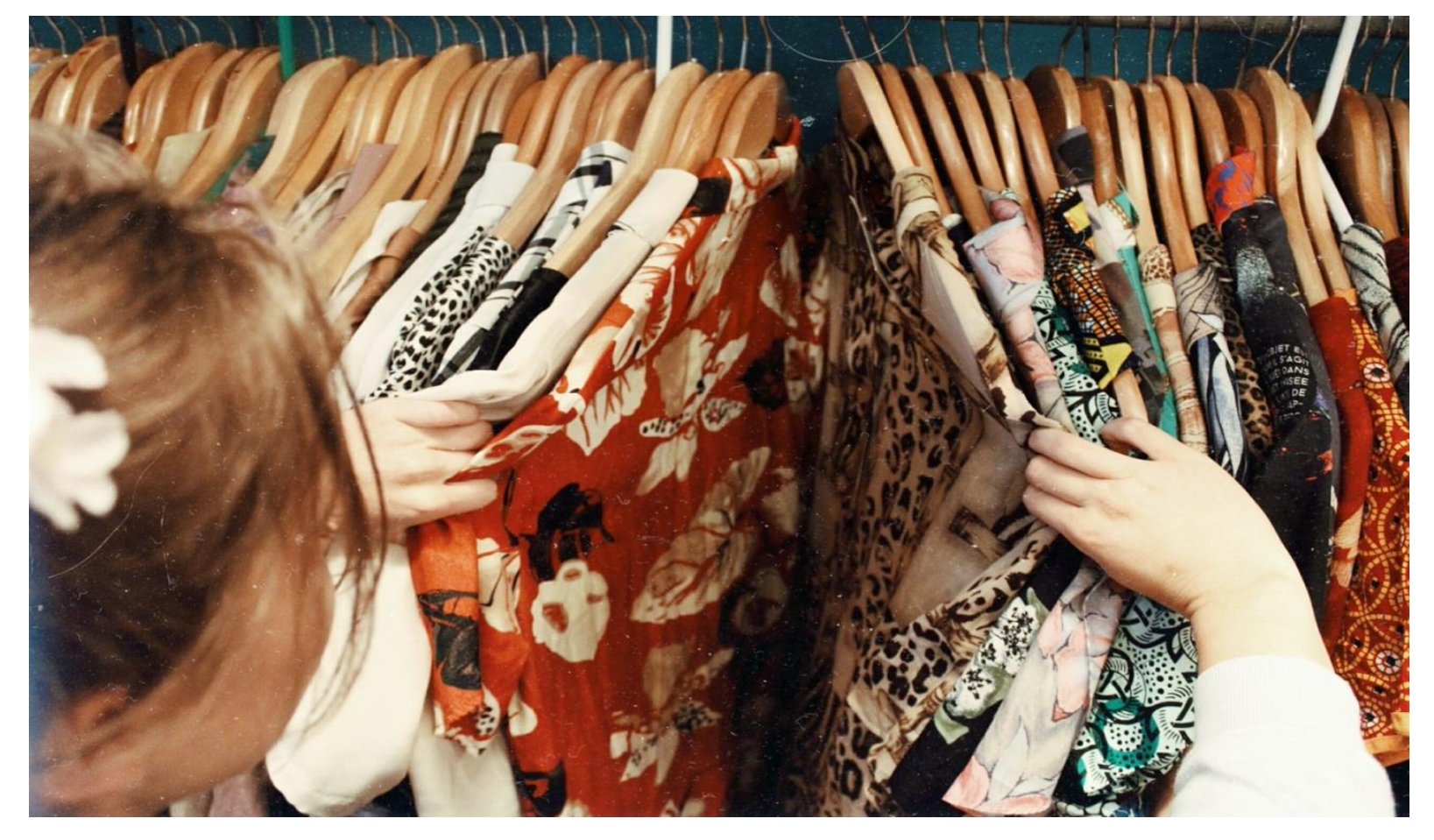
REUSE – Keep whatever you buy in circulation for as long as possible!
Many amazing, ethical businesses in Westport focus on clothing reusability.
Instead of buying new, consider buying “pre-loved” garments. Around the Rosey (specializing in children’s clothing), Designer Label Consignments in Westport, and Twice Is Nice in Southport are a few of the businesses that have become members of a growing market for ‘reused’ clothes.
If you want to dive deep into thrifting and wish to make a road trip out of it, check out the Best Consignment Shops in CT.
Don’t worry; if you’re a homebody who loves to shop online (like me!), find an online resale fashion platform, here: Best Online Consignment Stores 2023. Also, I’ve loved using Rent the Runway to rent clothes online, especially if I have a special place to be. You can also try Best Clothing Rental Services to find more options like this.
Repair is another excellent way to extend the life of those beloved items, and here in town, we have some fantastic tailors and cobblers (yes, that’s still a thing!).
Or, get creative and upcycle (The Benefits of Upcycling) by turning an old garment into a new design or repurposing the scrap fabric and “parts” for new uses.
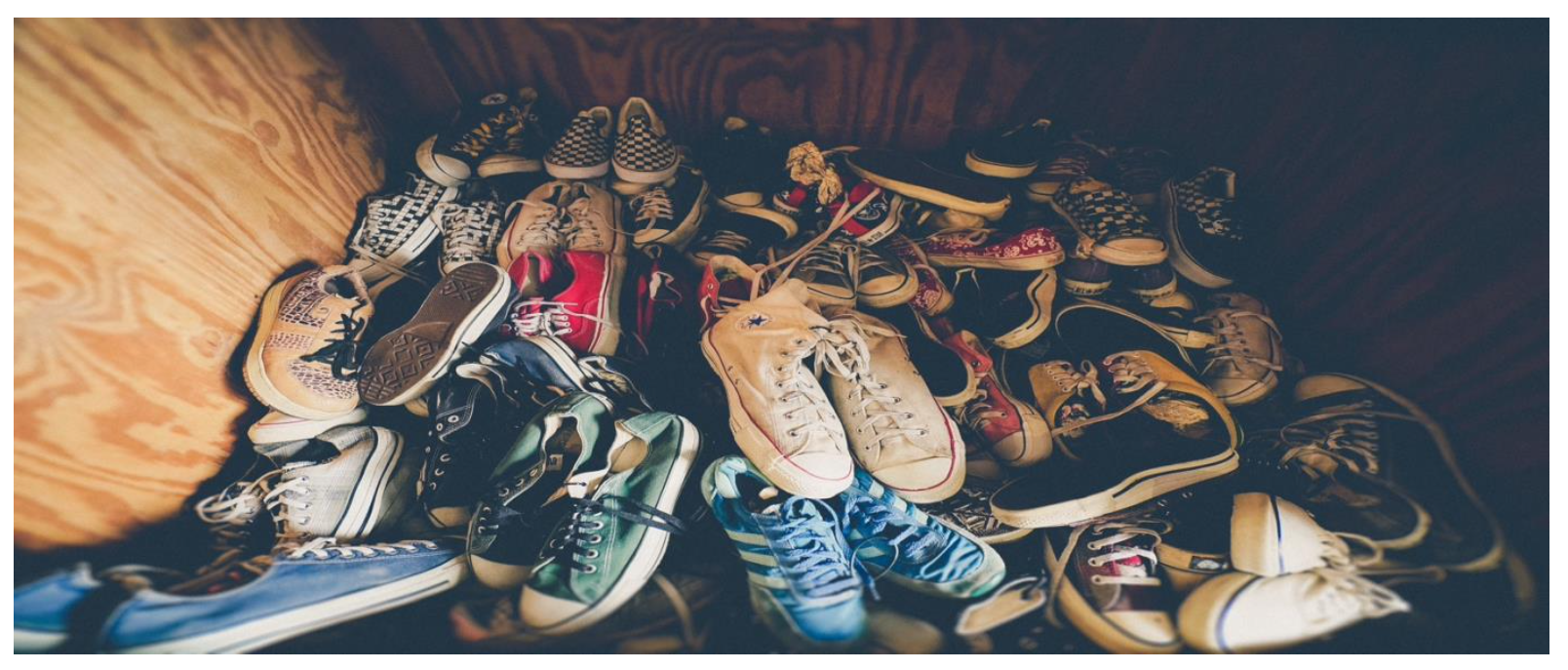
RECYCLE – Don’t judge, just donate!
What to do when you realize you must get rid of that cute hot pink dress that you’ve had since you were 20, with dreams that you’ll be able to fit back into it one day? Sorry, I’m projecting…
But seriously, there are so many great options when it comes to recycling clothes that you need to part ways with. Check out Sustainable Westport provides a great list of places to donate used clothing. Keep an eye out for other local clothing drives as well. For example, the Westport Woman’s Club is looking for gently used clothes to resell at the Curio Cottage on Imperial Ave. Greens Farms Church, on Hillandale, has a collection box where you can drop off used or unwanted garments to be donated to local non-profits in need.
Many fashion brands also have recycling programs. Take Madewell or Levi’s, for example, where you can donate denim from any brand, and the Nike Recycled Sneaker & Clothes Program, where you can drop off athletic shoes from any brand. Even if an item is badly stained, missing buttons, or torn, it can still be recycled into rags, pillows, stuffed animals, or insulation for various uses.
Bay State Textiles is a recycling no-judgment zone. They collect ALL dry donations into 40,000-pound bales and ship them to South America, where they sort them into categories. Anything in good condition is reused, and the balance is recycled.
With global apparel consumption expected to reach over 100 million tons annually by 2030, understanding how to reduce your contribution to this waste is a must, especially when considering that Americans throw away 80 pounds of textile waste per person every year.
Don’t think this is an impossible hill to climb, every individual has a part to play in the story of textile waste, and remember…
- The most sustainable garment is the one you already own!
- Whatever you buy, keep it in circulation for as long as possible!
- Don’t judge, just donate (as long as it’s dry)!
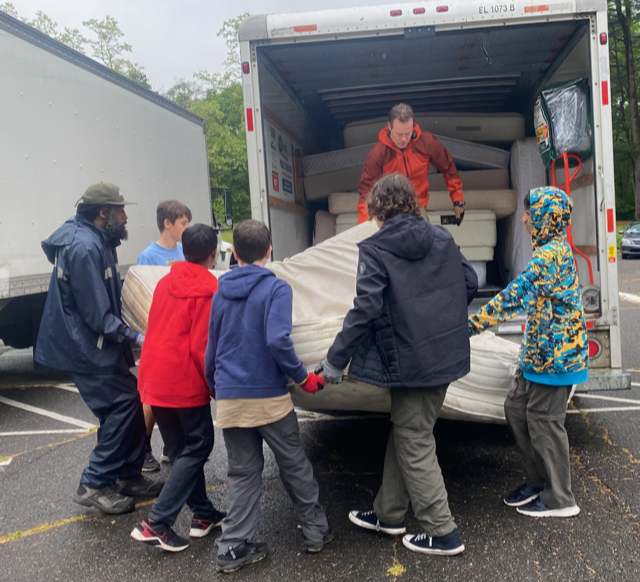
Westport Residents Support Mattress Recycling Event
The rain did not stop Westport residents from being part of the zero waste solution at this weekend’s Free Bi-Annual Mattress/Box Spring Recycling Event.
59 mattresses/box springs, weighing an incredible 3,231 lbs, were diverted from the trash with the help of our recycling partner Bye Bye Mattress. Over 90% of the material collected at the event can be recycled into new products, instead of ending up in a landfill or incinerator.
Special THANK YOU to Boy Scout Troop 36 for their hard work in the rain, picking up roughly 75% of the mattresses/box springs from our community!
Miss the recycling event? You can recycle your mattress or box spring anytime at (call ahead):
Park City Green
459 Iranistan Ave
Bridgeport, CT 06604
203-212-3858
Sustainable Westport Superstar: Jade Lan, Student at Coleytown Middle School
Congratulations to sixth-grade student, Jade Lan, for winning second place in the World of 8 Billion national video contest challenge!
Jade, who attends Coleytown Middle School, was inspired to create a video on environmental justice after reading a New York Times article about a young Houston family losing their recently-purchased home due to a natural disaster. She thought it was unfair that more affordable houses are often built in places that are more directly impacted by climate change/natural disasters. Before making her video, entitled “Monitoring Climate Injustice,” Jade was not aware of the growing population or its connections to climate change. She was shocked to learn that the countries that put out the least amount of emissions are also the ones most affected by climate change impacts.
The World of 8 Billion student video contest is a project of Population Education, a non-profit program based in Washington DC. This year, the organization received over 25,000 student-made videos that explain how population growth impacts one of the following global topics: Climate Change, Gender Equality, and Waste. In the video, students are also asked to offer an idea for a sustainable solution.
Jade’s video provides an excellent overview of the impact of population growth on climate change as well as her solution to keep countries accountable towards their commitments to change – a global progress dashboard. Check it out below!
Congratulations to Jade! Thank you for being a Sustainable Westport Superstar!

Westport Rotary Honors Sustainable Westport at Annual Day of Service Event
Sustainable Westport’s Co-Directors Gately Ross and Johanna Martell pose with Westport Rotary Club’s Giving Committee Chair, Peter Helt.
Sustainable Westport was recognized alongside 38 other community organizations at the Westport Rotary Club’s annual Day of Service event. Sustainable Westport’s Co-Directors Gately Ross and Johanna Martell were honored to attend the civic organization’s annual luncheon and to receive a $2500 Community Partnership Organization Grant.
Thank you to the Rotary Club for your ongoing support of our mission: to inspire, connect, and support the residents, businesses, and government of Westport in reaching our collective goal of becoming a Net Zero Community by 2050.